
In Solidarity: A Notion of Family, A Nation of Sisters
The Museum of Modern Art
Roxana Marcoci
May 3, 2024
Excerpt from the LaToya Ruby Frazier: Monuments of Solidarity exhibition catalogue
“From the very beginning, I have always been working with other women artists who are not seen as artists or as a part of this art world,” LaToya Ruby Frazier stated in a 2019 conversation with playwright Lynn Nottage. “I am intentionally collaborating with them and then giving their work a platform. It’s my mission: advocating for other women artists. Every single body of work, I’ve done it.” 1
Over more than two decades, Frazier has mapped a web of relations and social dynamics, reaching across generations to ensure that the lives of creative working-class women are seen and their voices are heard. For her 2024 survey exhibition at The Museum of Modern Art, Frazier has reconceived her distinct bodies of work as a sequence of multimedia installations that she calls “monuments for workers’ thoughts.” 2
More than merely reviving the past, her commemorations and celebrations of the ongoing labor, resilience, and creativity of working women act as a guidebook for action, a model for sisterly unity in the face of inequity and injustice.
Frazier joins a counterhegemonic chorus of artists and poets who uphold Black women’s stories of resistance and solidarity. This lineage includes the artist Kara Walker, whose 2014 public project A Subtlety—a massive, sugarcoated statue combining the traits of Sphinx and archetypal mammy—bears an extended title:
the Marvelous Sugar Baby
an Homage to the unpaid and overworked Artisans who have refined
our Sweet tastes from the cane fields to the Kitchens of the New World
on the Occasion of the demolition of the Domino Sugar Refining Plant.
Walker pays tribute to the overlooked creative agency of enslaved people, which took root even within the most inhumane of labor systems. Her description of the victims of slavery as “unpaid and overworked Artisans” radically reorients the histories of American art and labor, much as Frazier’s partnership with women artists who have gone unrecognized as such implicitly revalues the artistic canon. 3
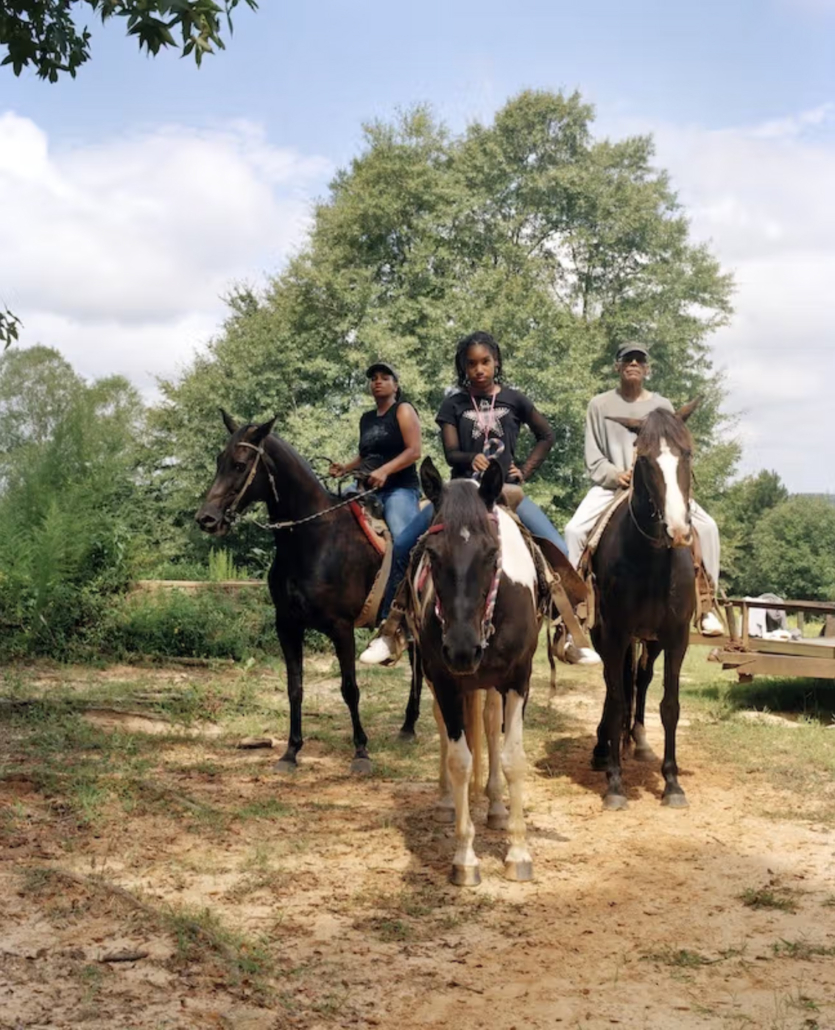
Mr. Smiley Riding on Their Tennessee Walking Horses, Mares, P.T.
(P.T.’s Miss One Of A Kind), Dolly (Secretly), and Blue (Blue’s Royal
Threat), Newton, Mississippi from Flint Is Family in Three Acts. 2017–19
In a 2022 keynote address at the Museum, Frazier stated, “It is incumbent upon me to resist—one photograph at a time, one photo-essay at a time, one body of work at a time, one book at a time, one workers’ monument at a time—historical erasure and historical amnesia.” 4
Growing up “in a household with a retired Black steel mill worker, my Grandma Ruby’s stepfather, who I called Gramps,” Frazier noted in a recent conversation with Marxist geographer David Harvey, “created my desire to see statues of working-class people instead of industrial capitalists.” 5
Rather than honoring the powerful, the artist’s alternative monuments recognize the histories, contributions, and lives of a multiracial working class from across a geographic spectrum: Braddock, Pennsylvania; Flint, Michigan; the Borinage mining region in Belgium; Lordstown, Ohio; Baltimore, Maryland; Delano, California. Moreover, the worker is not an allegorical figure: individuals, in solidarity with a larger collective, represent themselves. Open-ended, living, and relational, Frazier’s installations, through engagement with the viewer, are designed to awaken action. The artist proposes a world, in the words of Walt Whitman, “where no monuments exist to heroes but in the common words and deeds.” 6
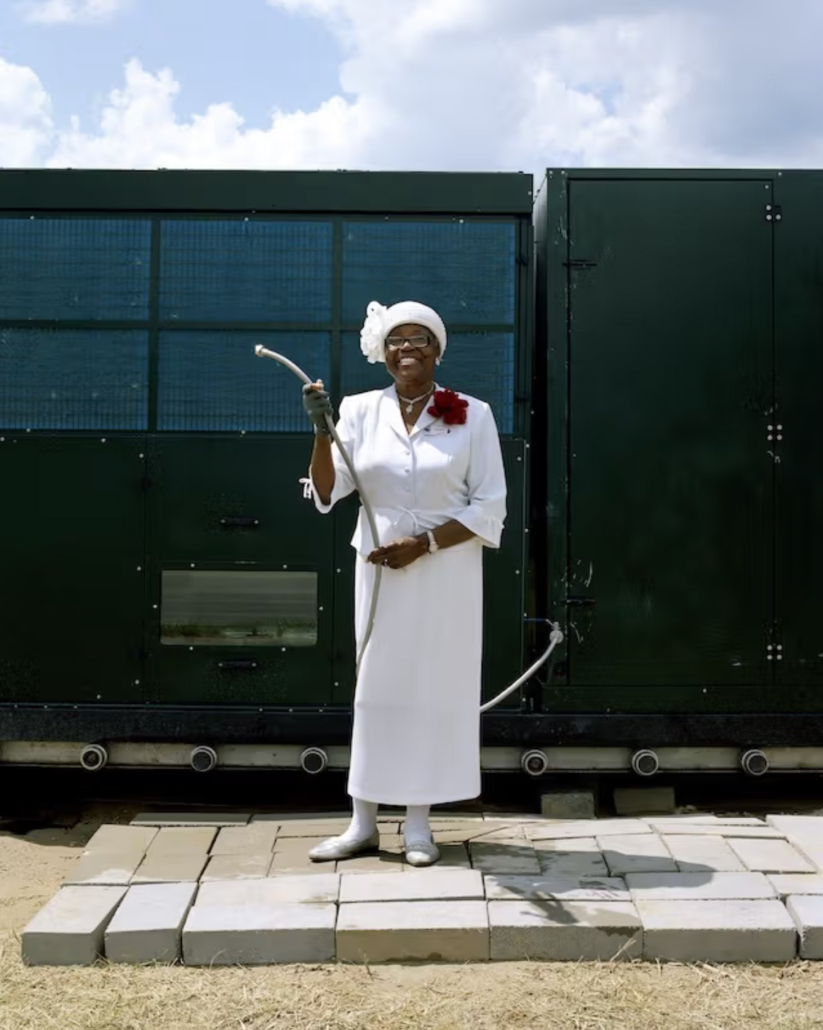
LaToya Ruby Frazier. Mary A. Williams, Tuklor’s Mother, Holding
the Water Hose at the Atmospheric Water Generator on North
Saginaw Street Between East Marengo Avenue and East Pulaski
Avenue, Flint, Michigan from Flint Is Family in Three Acts. 2019–20
Speaking to Frazier of the role memory plays in radical politics, Harvey outlined a dictum from the novelist Honoré de Balzac: “Hope is a memory that desires.” Monuments—as encapsulations of memory—are not always expressions of hopeful desire, but what if they were? “The historical role of memory,” Harvey elaborated, “the historical role of what people have done in the past becomes a powerful political force when merged with contemporary desires for a better life.” 7
With this in mind, we might ask whether the monument as a genre, understood in new ways, could hasten the demise of structural forms of violence and oppression. Contemplating the Martin Luther King Jr. Memorial in Washington, DC, and other American sites of memory, scholar Sarah Lewis observes, “If we are to understand which narratives about race and citizenship are created by monuments, we need to focus on considering their temporality anew. Do they historicize events or do they signal a narrative of futurity, an order, a narrative that will define a path of civic life?” 8
Frazier’s installations, while preserving histories, open horizons of possibility for an antiracist future. They are oriented toward what Lewis (quoting Black feminist theorist Tina Campt) describes as that which “should be true . . . striving for the future you want to see, right now, in the present.” 9
Courtesy of: The Museum of Modern Art
- LaToya Ruby Frazier, “Conversation,” interview by Lynn Nottage, in The Last Cruze (Chicago: Renaissance Society at the University of Chicago, 2020), 361.
- LaToya Ruby Frazier, “Keynote Statement,” LaToya Ruby Frazier Scholars’ Day, The Museum of Modern Art, New York, November 18, 2022, organized by Roxana Marcoci and Caitlin Ryan.
- See Raquel Kennon, “Subtle Resistance: On Sugar and the Mammy Figure in Kara Walker’s A Subtlety and Sherley Anne Williams’s Dessa Rose,” African American Review 52, no. 2 (Summer 2019): 143–64.
- Frazier, “Keynote Statement.”
- LaToya Ruby Frazier, “Conversation,” interview by David Harvey, in The Last Cruze, 316.
- This line from Whitman’s poem “Song of the Broad-Axe” (1856–81) provides the epigraph to Natasha Trethewey’s poetry collection Monument: Poems New and Selected (Boston: Houghton Mifflin Harcourt, 2018). Like Frazier, Trethewey has articulated the contemporary monument as a mode of resistance to historical erasure, its workings continuously expansive—both tangible and intangible. In this framework, a monument can be a poem or a relationship; it can be celebratory or denunciatory. Special thanks to architectural historian Amber Wiley, who first mentioned Trethewey’s work at LaToya Ruby Frazier Scholars’ Day, The Museum of Modern Art.
- Harvey, in Frazier, “Conversation,” interview by David Harvey, 315.
- Sarah Lewis, “A Questionnaire on Monuments,” October, no. 165 (Summer 2018): 98.
- Tina Campt, Listening to Images (Durham, NC: Duke University Press, 2017), 17. Quoted in Lewis, “A Questionnaire,” 93.
