
What the Art World Can Learn From Women’s Basketball
Cultured Magazine
Sophia Cohen
Sophia Cohen speaks with New York Liberty Owner Clara Wu Tsai about how she has transformed the Liberty’s home at Barclays Center into a cultural and entertainment hub.

LaToya Ruby Frazier, THE LIBERTY PORTRAITS: A MONUMENT TO THE 2024 CHAMPIONS (2024-2025), 2025. Photography by Daniel Greer at the Barclays Center. Image courtesy of the artist and Gladstone.
I’ve spent my fair share of time in sports stadiums and arenas. Like museums, they are special places where a wide variety of people come together with a common goal to witness excellence. The businesswoman and philanthropist Clara Wu Tsai—who owns the Brooklyn Nets, Barclays Center, and, as of 2019, the New York Liberty—is working to bring the worlds of art and sports closer together. A noted collector, she has been collaborating with artists including LaToya Ruby Frazier, Sarah Sze, and Rashid Johnson to develop ambitious art for the Brooklyn stadium.
I tried my hand at combining these two sectors last year, when I helped develop a line of artist-designed tote bags and hats for the New York Mets. The experience made me eager to connect with Wu Tsai, who has helped Barclays evolve into the culture and entertainment platform it is today. This month, the stadium unveiled a new project by Frazier, the artist’s first public work. Frazier designed nine-foot-tall portraits of each player on the Liberty’s 2024 championship-winning roster—one side features a portrait of a player in uniform, and the reverse showcases the same player with their chosen family.
I chatted with Wu Tsai about what it means to commission with care and what the art world can learn from her masterclass in reaching new audiences.
Sophia Cohen: I’m really happy we’re doing this. I feel there’s a lot of synergy between us—loving art and loving sports. You’re way more actively involved as a co-owner, whereas I’m just the family of [the owner, Steve Cohen is Sophia’s father]. But we both want to bring art out of the white cube. I’d love to hear a little more about the Social Justice Fund, which aims to address systemic inequality in Brooklyn, and the development of your public art projects.
Clara Wu Tsai: The Social Justice Fund started in 2020, and one of our first projects was a public art commission: the neon art installation by Tavares [Strachan] that states, “We Belong Here” in Tavares’s own cursive script. This phrase is somewhat of an anthem of the Social Justice Fund. It is a message that we hoped could instill a sense of agency and a belief that all people in Brooklyn can coexist in beautiful ways. We have a belief that art is a powerful tool for fostering empathy and community. We believe that art should be accessible to all. These themes form the basis for why we want to commission more public art at the Barclays Center.
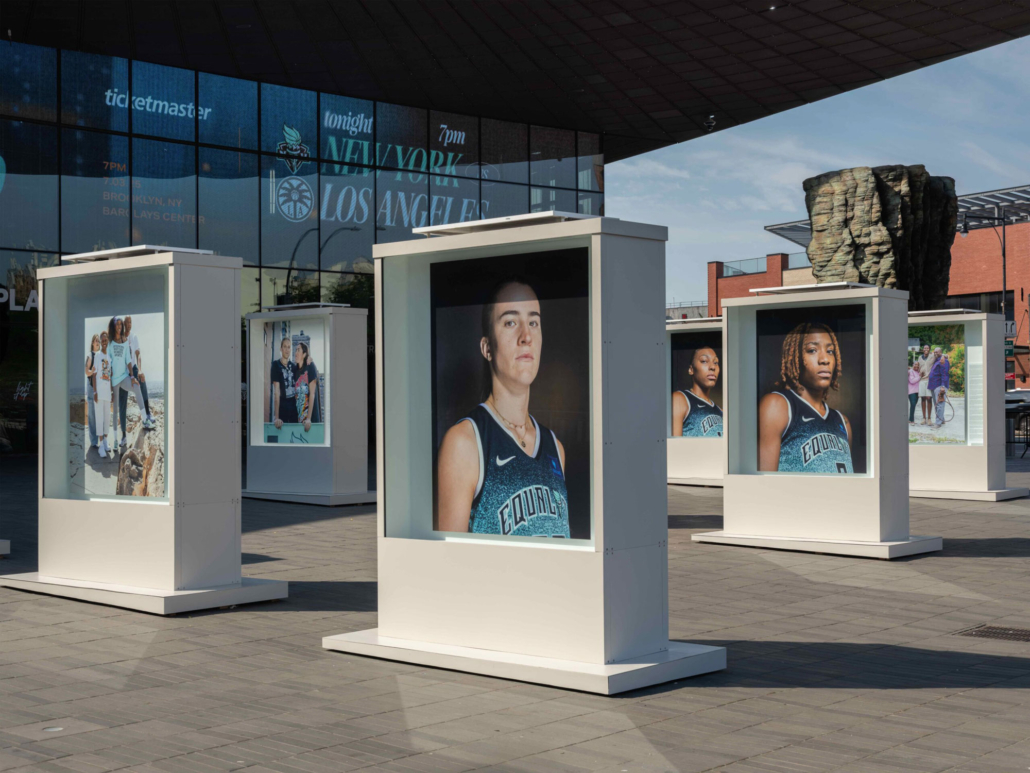
LaToya Ruby Frazier, THE LIBERTY PORTRAITS: A MONUMENT TO THE 2024 CHAMPIONS (2024-2025), 2025. Photography by Daniel Greer at the Barclays Center. Image courtesy of the artist and Gladstone.
Cohen: You’re working with LaToya Ruby Frazier, Sarah Sze, and Rashid Johnson. I’ve actually worked with Rashid and Sarah Sze on a [New York] Mets project, so I know how excited they are to be more involved in New York sports. Gavin Brown represented LaToya Ruby Frazier when I was working there, so I know her artwork very well, but I’m so curious to hear her take on this project.
Wu Tsai: I met LaToya through the Gordon Parks Foundation in 2023, the year that I was honored at their gala. In my remarks, I talked about how I was motivated to follow Parks’s example in using art and storytelling to bring visibility to the WNBA. That resonated with LaToya because she is a former basketball player and has always wanted to tell their stories. When we met, we quickly discovered our shared passion for basketball and uplifting women athletes.
When we initially talked about her doing a project about the players of the New York Liberty, she was just getting ready to mount her show at MoMA, and so the timing wasn’t right. The following year, we advanced to the championship round for the second time. We thought this was the right time to create a series of portraits of the team.
LaToya focused on making sure the players didn’t feel that she was just a photojournalist. She really embraced the players. She noticed the duality—they’re heroes, but she also wanted to reveal their humanity. In their display cases, the pieces are about nine feet tall. There are family portraits alongside images of each player with their game face on, and there are also family testimonials, which are an essential part of the project. She traveled to their hometowns and took the time to connect with them.
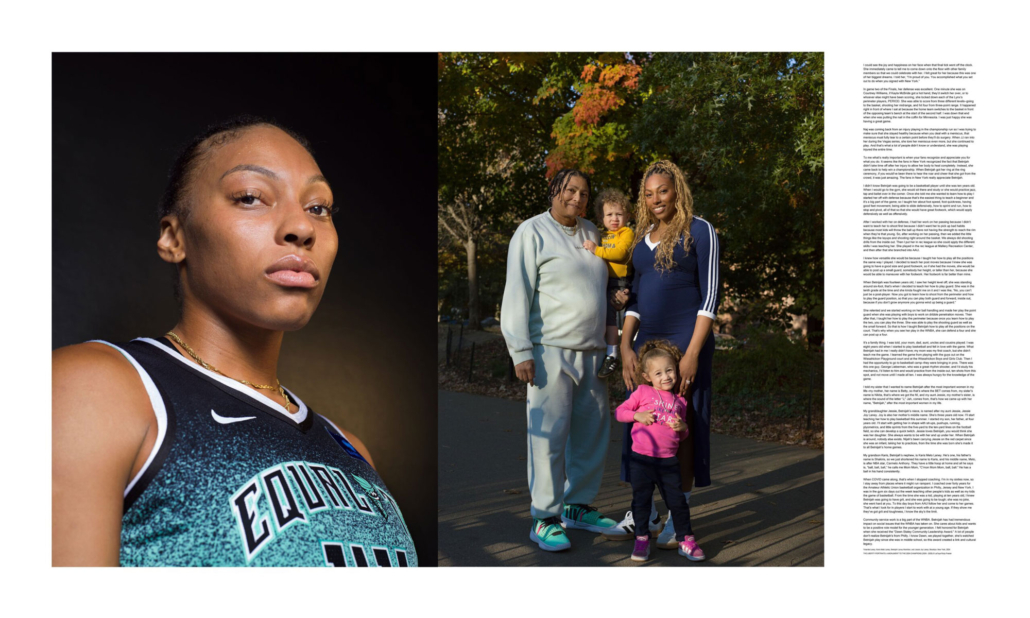
LaToya Ruby Frazier, Yolanda Laney, Karis Melo Laney, Betnijah Laney-Hamilton, and Jessie Joy Laney, Brooklyn, New York, 2024, from THE LIBERTY PORTRAITS: A MONUMENT TO THE 2024 CHAMPIONS (2024-2025). Image courtesy of the artist.
Cohen: I’d love to talk about bringing the Liberty to Barclays and putting them on an equal playing field with the NBA. What was your mindset in doing that?
Wu Tsai: When we bought the team, they were playing in Westchester County Center, an arena that had a seating capacity of 2,000. In the early days, the team played at Madison Square Garden to crowds of 18,000. So one of the first things we did was bring them to Barclays Center, where the Brooklyn Nets play. The vision was to field a team that could win, bring the old fan base back, and attract new audiences. We believed in the business potential of the WNBA. We started to invest in the team, in player health and wellbeing, and in nutrition and performance. We felt that women’s sports had been underinvested in.
Cohen: As you said before, [working with] artists and athletes can be similar: there’s always a little bit of a dance with what’s possible and where to meet in the middle. I’d be curious to hear about surprises that arose while working with artists or complexities that you found interesting as both a collector and a sports team owner.
Wu Tsai: Realizing the vision for this project was complex. With the Monument to Champions, the idea was conceived by the artist in collaboration with me. When you have an art project involving the entire team, there is a process to get the players to buy in. We invited them to a tour of LaToya’s MoMA show in its final weeks—it was a great way to introduce them to her work, and for LaToya to share more about her process. We wanted to give the team the time to understand and embrace LaToya’s approach to storytelling.
This is her first public art piece. She was very involved in designing the sculptural installation, as much as shooting the portraits themselves. She was interested in the sightlines of the portraits and how they will be experienced by visitors and fans as they move through the plaza and into the arena. Through all the difficulties in scheduling shoots with the players and their families, she was very gracious. Public spaces always have so many unexpected parameters—weather, light, egress. While I am sure that some aspects were not what she had envisioned, she was incredibly agreeable and joyful from start to finish. […]
Courtesy of: Cultured Magazine
