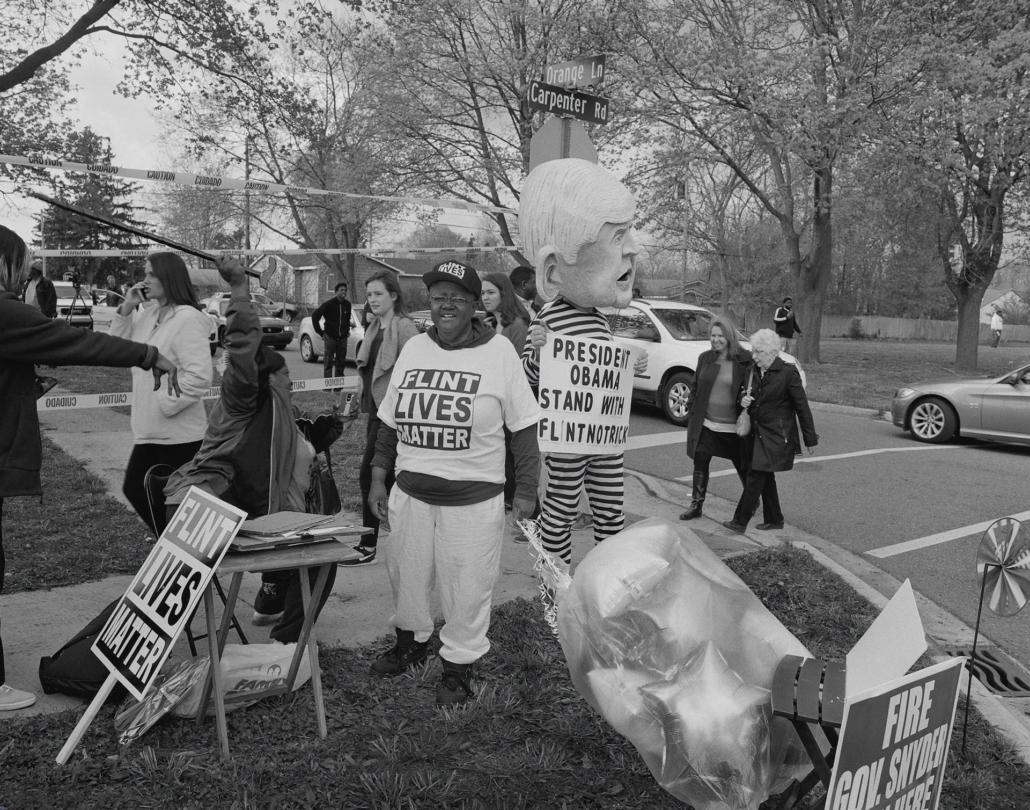
LaToya Ruby Frazier: Flint Students and Community Members Outside Northwestern High School (Est. 1964) Awaiting the Arrival of President Barack Obama, May 4, 2016, Flint, Michigan, Ill, 2016–2017. Gelatin silver print. 20 x 24 inches.
A global recession, a pandemic, 9/11, the Arab Spring, Brexit, the rise of Web 2.0, unrest in the face of economic stability, wars in Afghanistan, Ukraine, Gaza, and elsewhere: these were but a few of the many events that have defined the past 25 years, a period characterized by tumult and uncertainty. That all may explain why art appeared to change faster than ever all the while, with artists burning through styles and tendencies with each coming year.
With the 21st century now at the quarter point, we’ve taken the opportunity to pinpoint the greatest artworks of the past 25 years. Even though we set down some parameters for ourselves (more on that here), it was no small task—one made more difficult by the restless creativity of artists during this period.
The joy of an epic list like this one is that it can’t encapsulate everything: we know we’ve left some artworks off, simply because there was no shortage to choose from. We hope you’ll discover some amazing pieces here, reflect on some that are much-loved already, and debate the merits of others. And moreover, we hope to learn of new artworks through the conversations we hope our list inspires. […]
This article features contributions from the following writers:Francesca Aton, Andy Battaglia, Daniel Cassady, Anne Doran, Sarah Douglas, Maximilíano Durón, Alex Greenberger, Harrison Jacobs, Tessa Solomon, and Emily Watlington.
https://latoyarubyfrazier.com/wp-content/uploads/2016/12/LRF_logo_2016.png00Webmasterhttps://latoyarubyfrazier.com/wp-content/uploads/2016/12/LRF_logo_2016.pngWebmaster2025-03-06 11:13:002025-07-09 12:34:45The 100 Best Artworks of the 21st Century
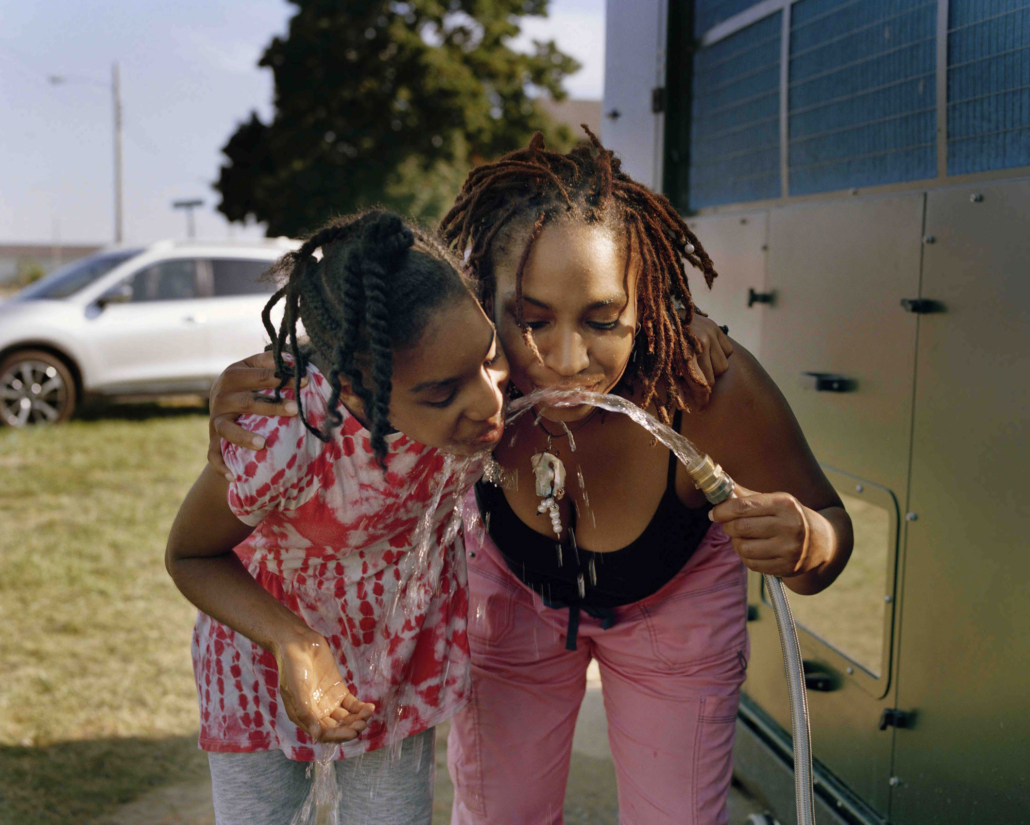
Zion Taking Her First Sip of Water from the Atmospheric Water Generator with Her Mother Shea Cobb on North Saginaw Street Between Morengo Avenue and East Pulaski Avenue, Flint, Michigan, 2019. From the series Flint Is Family, Part II (2017-2019) by LaToya Ruby Frazier.
Literally sent from the raging fires in Los Angeles, Breath(e): Toward Climate and Social Justice just arrived at the Moody Center for the Arts at Rice University. Organized by the Hammer Museum, it is on view in Houston through May 10. That a show about climate change would flee LA under such duress might seem uncanny if disaster wasn’t becoming so terrifyingly commonplace.
The exhibition, however, veers clear of outright terror; there’s enough of that in the news. Instead, 14 resoundingly smart artists experiment with solutions, some of them literal, as with Xin Liu’s work with a solvent capable of dissolving plastic. Others are speculative, as in Cannupa Hanska Luger’s sculptural installation of looming Indigenous space travelers clad in protective gear made from recycled materials, nomads surviving in a hostile environment.
The show was adapted to Houston’s local climate, with works attending to the particularities of the Gulf Coast landscape and to the city’s role as the so-called energy capital of the world. Liu is using the solvent—developed in a Rice lab—to slowly degrade 3D-printed models of downtown Houston and the Rice campus. Luger’s figures are backed by a threaded horizon line that replicates Houston’s low-lying topography, and accompanied by a video featuring the oaks outside the Moody, connecting the here and now to the future possibilities his work conjures.
[…]
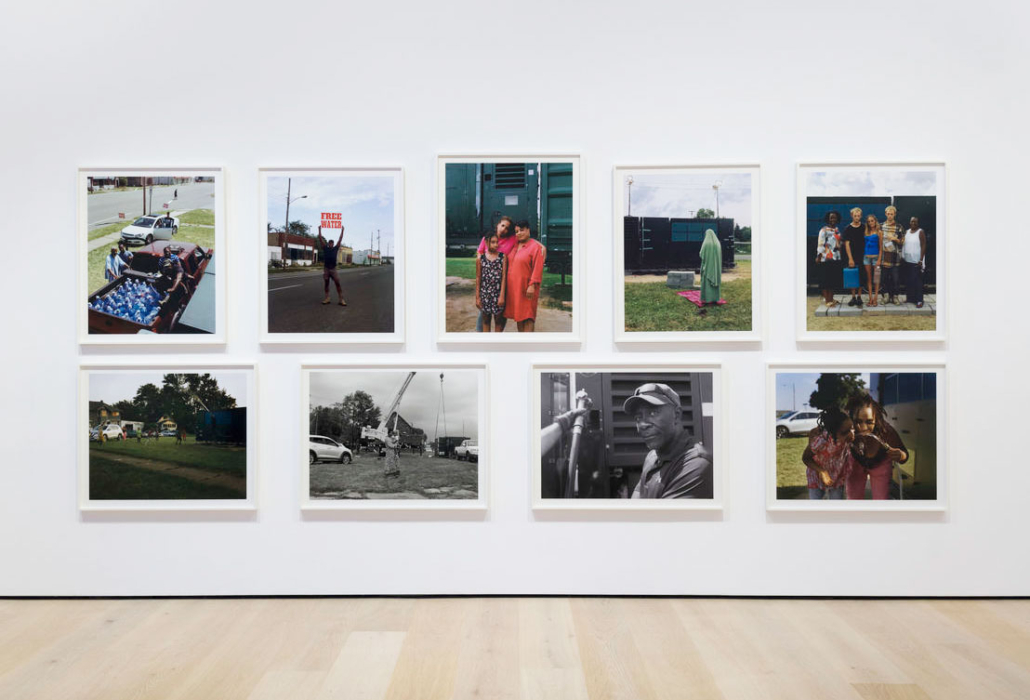
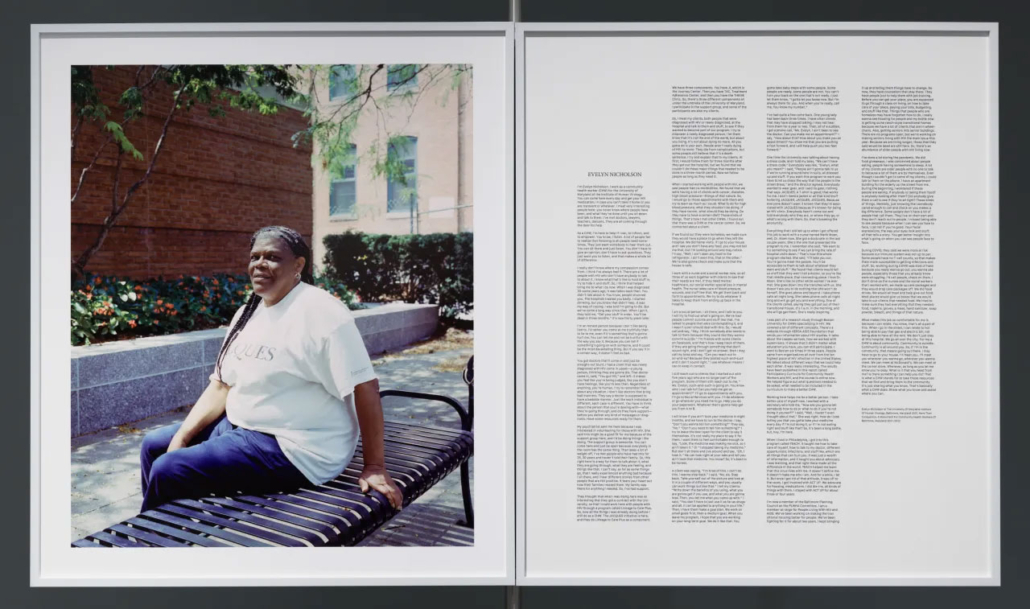
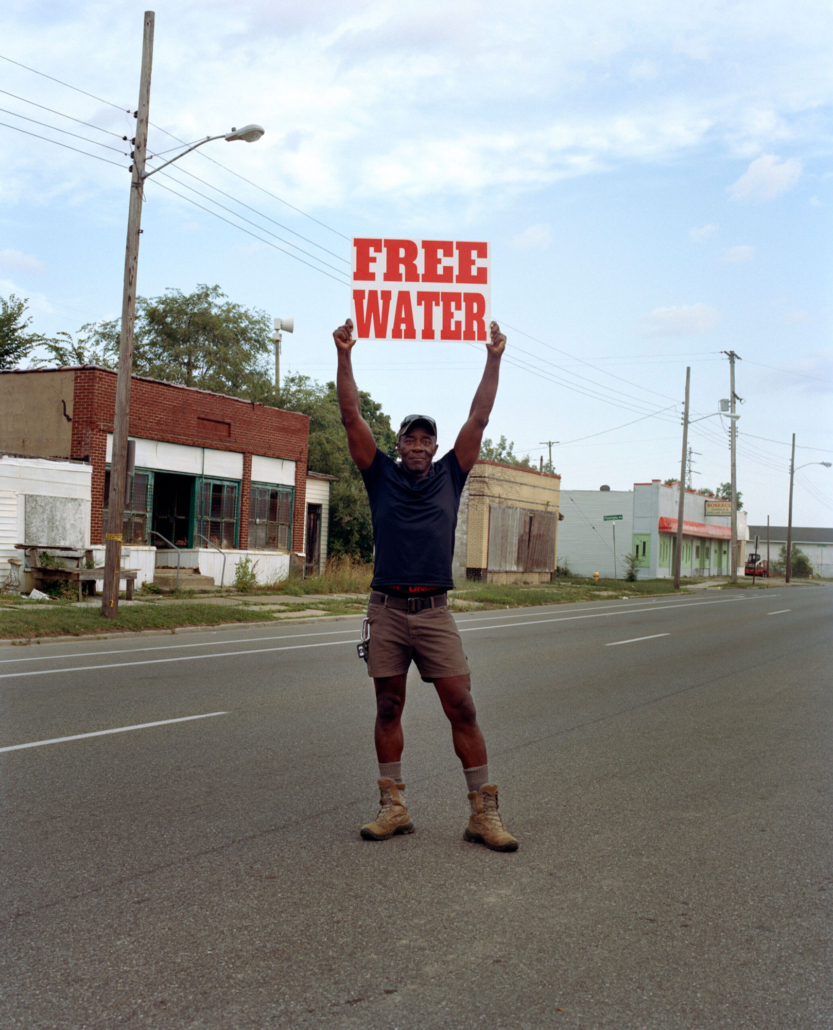
Hope, Rebecca Solnit has written, is the belief that what we do matters. It comes from the realization that not only is another world possible, but that it’s already here. LaToya Ruby Frazier’s contribution shows us this other world, driven by goodness rather than greed. Her Flint is Family photographs (2016–22) depict the community affected by the famed Flint water crisis. The third and final act of the series is on view at the Moody: it documents the contributions of Moses West, the engineer responsible for an atmospheric water generator that provided safe, clean, and free water to Flint by collecting condensation from the air. The photographs show moments of exuberant relief as residents worked together to distribute the water. The pictures stand as proof that in the wake of disaster, there are people who will still prioritize generosity, resourcefulness, and altruism—something to hold on to as the disasters keep coming.
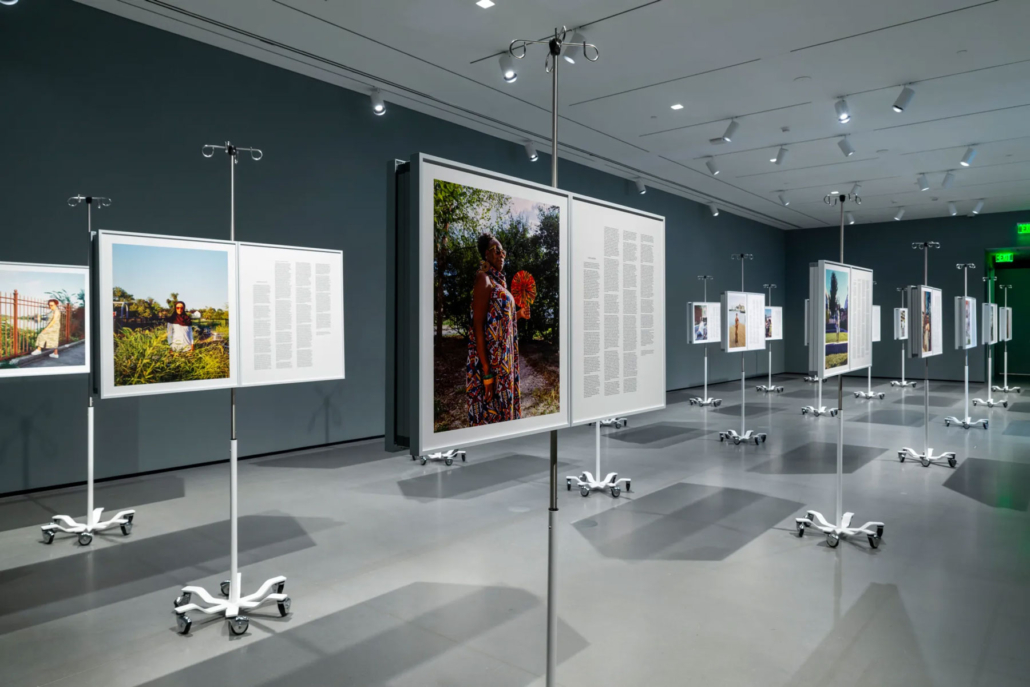
LaToya Ruby Frazier, More Than Conquerors: A Monument for Community Health Workers of Baltimore, Maryland 2021-2022, 2022, 18 stainless steel IV poles, 66 ink-jet prints and text panels. Installation view, Baltimore Museum of Art, 2024. Photo: Mitro Hood.
LaToya Ruby Frazier is an imagemaker and a prominent advocate for visual justice and democratizing museum spaces. For more than two decades, she has created artwork that honors the seldom represented lives of people from working-class backgrounds and America’s industrial heartland. Initially created for the Fifty-Eighth Carnegie International (2022–23)—where it won the Carnegie Prize—her acclaimed installation More Than Conquerors: A Monument for Community Health Workers of Baltimore, Maryland 2021–2022, recently entered the Baltimore Museum of Art’s permanent collection, where it is currently on view through March 26, 2025.
The photographic installation features a series of portraits of health care workers and their related testimonies, each mounted on one of eighteen stainless-steel medical IV poles positioned at socially distant intervals, the result of a multiyear collaboration with a Baltimore-based network of doctors and health care professionals who were frontline workers during the Covid-19 pandemic, and whose responsibilities included dispensing the vaccine to underserved communities. More specifically, it is a testament to the selflessness of Community Health Workers (CHWs), public health workers who serve as a bridge between the health care system and the community served, risking their lives for what is often less than minimum wage. Monumental in its scale and impact, More Than Conquerors makes invisible folks visible and allows people of color in Baltimore, a predominantly Black city with a history of medical racism, to have their words and images viewed in their flagship museum. Here, the artist discusses the work’s collective beginnings, her mission to democratize museums, and the creation of alternative monuments.
LaToya Ruby Frazier, More Than Conquerors: A Monument for Community Health Workers of Baltimore, Maryland 2021-2022 (detail), 2022, 18 stainless steel IV poles, 66 ink-jet prints and text panels. Installation view, Baltimore Museum of Art, 2024. Photo: Mitro Hood.
I’M FROM BRADDOCK, PENNSYLVANIA, a historic steel town. It is where Andrew Carnegie’s first steel plant, the Edgar Thomson Steel Works, is located and still operates, and it is where his first free public library was built. Being from a town that has all these monuments for industrial capitalists, to then switch to Baltimore, another industrial Black working-class town with these monuments erected to George Washington, allows me to consider and think about ways to subvert those types of power. It has given me a deep poetic sense and responsibility to help Americans see this history in the twenty-first century.
In 2015, the Contemporary and the Baltimore School for the Arts brought me together with Dr. Lisa Cooper of the Johns Hopkins Center for Health Equity. They asked us, “What could happen if an artist and a doctor collaborated? Could you make art that would be useful for society?” That planted the seed, and here we are, nine years later.
Dr. Cooper and her colleague Dr. Chidinma Ibe introduced me to their whole team. Dr. Ibe taught me about “Amplifying the Lived Experiences of Community Health Workers (ALEC),” her board-approved study with health workers, while Dr. Cooper kept emphasizing “Photovoice,” which is a method doctors use when they work with patients who have to remain anonymous for the sake of scientific objectivity, so doctors give them cameras and send them across the city. That’s when I knew that the best way to put working-class people at the center of an exhibition would be to use Photovoice. In this case, participants photographed and depicted social determinants of health (the socioeconomic factors that affect one’s health and well-being, such as income and neighborhood) and then wrote two hundred words about why they took that photograph.
I said to Community Health Workers: “I want to create your presidential portrait.” During the time creating this series, Dr. Ibe and I met with four cohorts of health workers on Zoom. I showed them some of my past work (The Notion of Family, 2001–14, and Flint Is Family, 2016) to teach them how to compose photographs. What’s amazing about integrating amateur photographers’ work with mine is that I’m treating them like they are contemporary artists worthy of being seen as contemporary artists, even though they may not be formal practitioners. The way the Monument is designed means that CHWs are now recipients of a Carnegie Prize. Andrew Carnegie must be turning in his grave.
When you think about the tall order that health workers have been given to overcome in Baltimore due to structural, spatial, and institutional racism, as well as an invisible virus that was killing all of us indiscriminately, on top of years of disenfranchisement from the steel industry, you would have to come up with that title: More Than Conquerors. A monumental, forceful title that is part gospel celebration, part actual biblical scripture.
[…]
LaToya Ruby Frazier, More Than Conquerors: A Monument for Community Health Workers of Baltimore, Maryland 2021-2022 (detail), 2022, 18 stainless steel IV poles, 66 ink-jet prints and text panels, each 28 × 24”. Photo: Mitro Hood.
My work has a very specific mission: to help museums be on the right side of history, to help them question their own power structure, their social caste system. The best way to do that is to democratize the arts. That’s one part of the Monument‘s mission; the other is to allow everyday Americans to come into a national museum and feel welcomed into that space, to understand that that museum is a part of them because that’s their city and where they pay taxes, and they have a right to access it. And finally, that they can see themselves represented with an exhibition about them and their lives.
I’m trying to set an example for artists who want to make work about social justice and cultural change in the art market, who want to change the art world and change museums. You do that by offering an opportunity to gallerists and collectors to do something meaningful with you, which, here, is to ensure that the work permanently goes to the Baltimore Museum of Art, the city where it originated.
The immense challenge of the next four years is very real, and I think that the art world should recognize and send support and resources to artists who are willing to risk their livelihoods to do important work to make this country a better place, uphold American democracy, continue to fight for the reconciliation and healing our citizens need, and keep reaching for visual justice.
https://latoyarubyfrazier.com/wp-content/uploads/2016/12/LRF_logo_2016.png00Webmasterhttps://latoyarubyfrazier.com/wp-content/uploads/2016/12/LRF_logo_2016.pngWebmaster2025-01-17 07:50:002025-07-08 08:05:30LaToya Ruby Frazier: On her monument to the Community Health Workers of Baltimore
Review: Diaries of Home at the Modern Art Museum of Fort Worth
I’m a 41-year-old woman and for most of my life the adults around me — educators, mentors, family — have given me the same consistent advice, “Whatever you do, don’t get pregnant.” As an adolescent I was baffled by these words because having children was not an interest or priority to me — it felt like the adults around me didn’t know me at all. As a young adult, I was incredulous, as I saw it, it was my life and I would prioritize what was important to me. Even now (yes, I still get this advice), I scoff at the desire others have to voice their opinions about any person’s decisions on when (if at all) to start a family and how many children to have.
With age, I have come to at least empathize with the advice these well-meaning adults have tried to share. Yes, having children necessarily requires your life to shift — it is a physical, emotional, financial, life-long commitment. As an artist and single parent, having children has meant that some experiences are off the table for me. But, my children add much more to my life than I could explain in words. As their parent, I strive to shape them but in turn, they shape me as well. Often, my children appear in my art and in my writing, and even when they aren’t directly referenced, their spirit is there because they have changed my understanding of the world various times over. It’s like Octavia Butler wrote in Parable of the Sower, “All that you touch you change. All that you change changes you.”
It is with the weight of this lifelong advice about children and the act of balancing my decision to have a family and continue my artistic practice, that I walked into Diaries of Home at the Modern Art Museum of Fort Worth and felt understood and validated as an artist and mother in a way that no other exhibition has done. Co-curated by Andrea Karnes, the museum’s Chief Curator, and Clare Milliken, Assistant Curator, the show features pieces by 13 women and nonbinary artists working in photography and lens-based media to explore concepts of home, family, and community. Beyond my personal connection to the content in the show, as a photographer, I also appreciated the variety of photographic approaches presented.
[…]
LaToya Ruby Frazier, “Home on Braddock Avenue,” 2007, gelatin silver print, 20 x 24 inches. Courtesy of the artist and Gladstone Gallery.
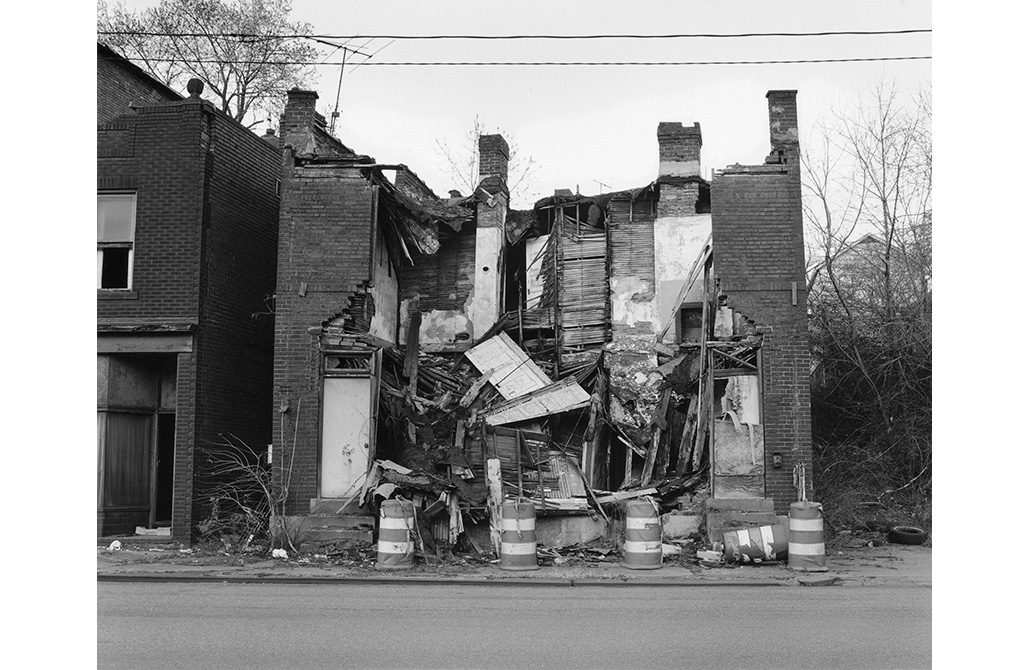
LaToya Ruby Frazier’s more documentary-style photographs of her hometown, Braddock, Pennsylvania, and scenes from Flint, Michigan fill a large gallery in Diaries from Home. Her series The Notion of Family was created from 2001 to 2014. Like Dugan’s Family Pictures, Frazier’s series documents three generations. Frazier presents the everyday moments and ordinary details that make up the lives of her grandmother, her mother, and herself. These images are juxtaposed with photographs of desolate scenes around the town, including a dilapidated building and a pile of rubble, together the body of work critiques the systemic and systematic issues faced by Black communities.
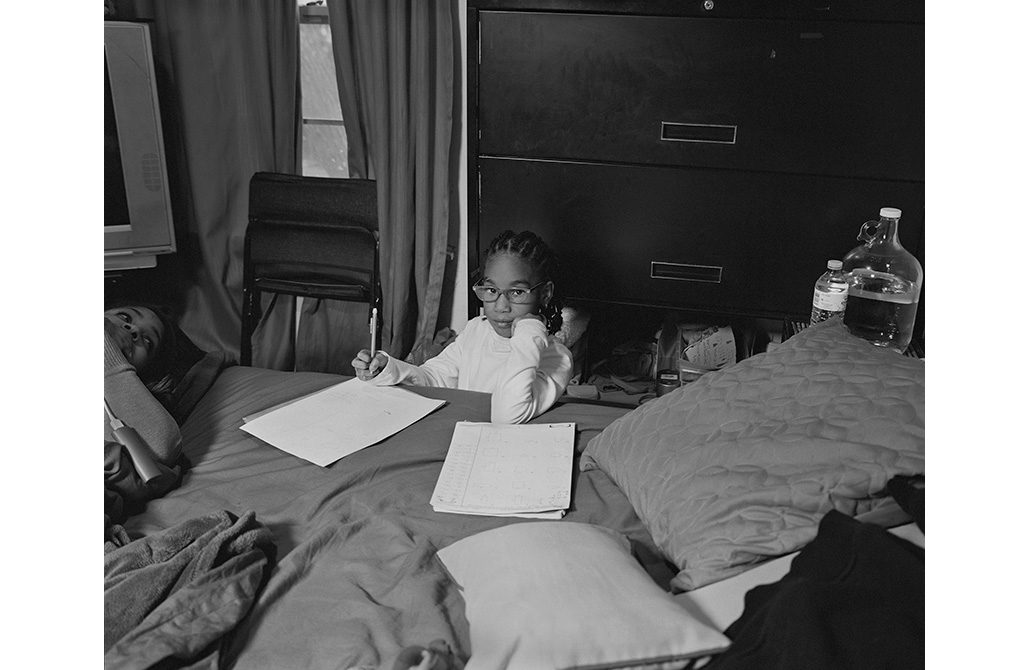
Frazier’s series Flint is Family, includes images taken from 2016 to 2021 detailing the lived experiences of the community as a result of the water crisis that began in April 2014, when the City of Flint switched its water source from Lake Huron to the Flint River. The photographs on view show students and community members awaiting the arrival of President Barack Obama, reference the continuation of daily moments like completing homework with water bottles ever present, and document the arrival of the atmospheric water generator, a temporary solution to the ongoing problem.
[…]
Beyond the artists I’ve mentioned, Diaries of Home includes works by Patty Chang, Nan Goldin, Deana Lawson, and Laura Letinsky. The exhibition covers a lot of ground and beautifully shifts between photographic and lens-based styles, showcasing traditional documentary and portraiture while also bringing in video works and AI-generated imagery. Presenting a range of styles is necessary in a photographic show because often the medium is viewed in confined and formal ways, when in reality there are many working to push the form in innovative directions.
The show also builds on the Modern’s 2022 exhibition Women Painting Women, by showcasing women and nonbinary artists, perspectives that have historically been left out of the art canon and other official records. Highlighting these artists in turn provides much needed representation of the varying experiences of female-identifying and nonbinary people, which creates counter-narratives to the socially constructed ideas that are prevalent around gender. These images and accounts capture moments of happiness, love, playfulness, strength, nostalgia, discomfort, loneliness, and struggle. They fill in nuances and reveal deeper truths about the past, present, and future in terms of family, home, and community. More than anything, Diaries of Home validates that there are a myriad of ways to live and document our lives, while reminding us that home is where we make it and with whom we make it.
Diaries of Home is on view at the Modern Art Museum of Fort Worth through February 2, 2025.
https://latoyarubyfrazier.com/wp-content/uploads/2016/12/LRF_logo_2016.png00Webmasterhttps://latoyarubyfrazier.com/wp-content/uploads/2016/12/LRF_logo_2016.pngWebmaster2024-12-17 14:51:212025-01-07 15:09:12Reflections on Home, Family, and Representation
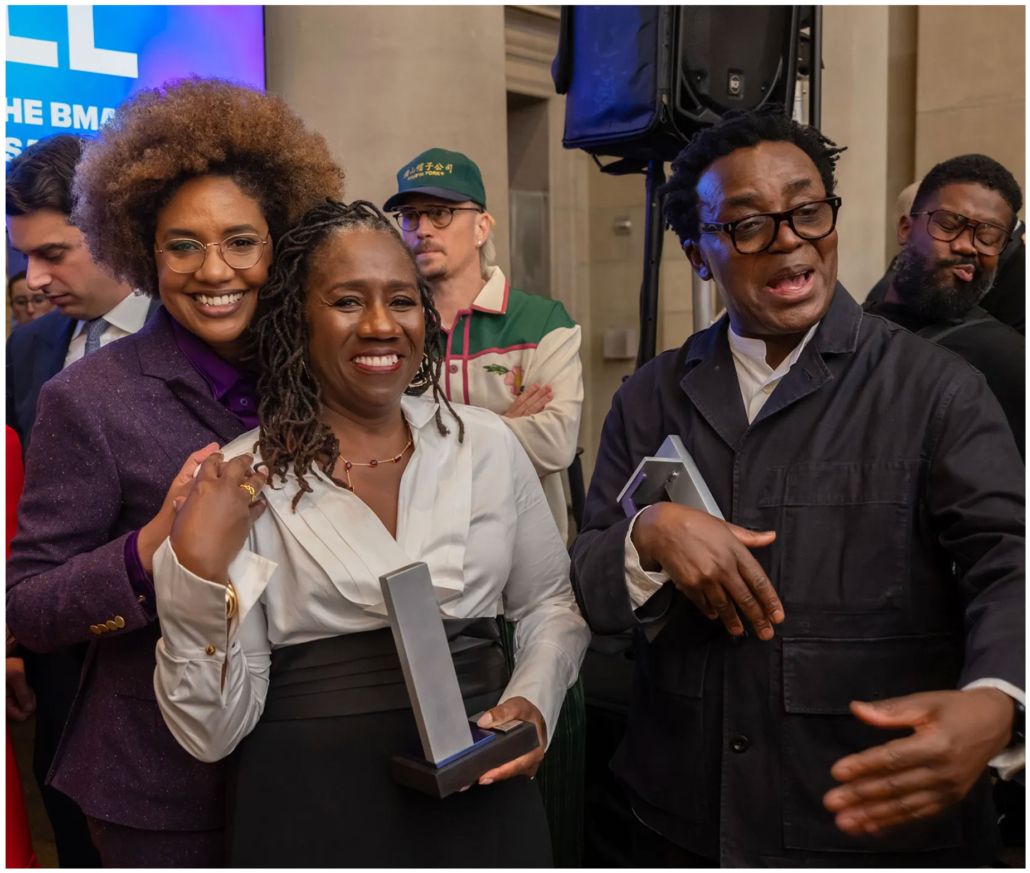
Paying tribute to the vast talents of artists John Akomfrah and LaToya Ruby Frazier and civil rights lawyer Sherrilyn Ifill with inaugural awards was the highlight of the evening.
The Baltimore Museum of Art’s Ball and Party honored artist LaToya Ruby Frazier; artist John Akomfrah; and BMA Trustee, civil rights lawyer, and scholar Sherrilyn Ifill. | Photo by Maximilian Frazier
THE BALTIMORE MUSEUM OF ART (BMA) hosted a gala celebration on Nov. 23. The BMA Ball and Afterparty marked the institution’s 110th anniversary and launched new awards of recognition. The state’s political elite showed their support. Maryland Governor Wes Moore and First Lady Dawn Moore served as honorary co-chairs, along with former Baltimore Mayor Kurt Schmoke and Patricia Schmoke, M.D. Former Governor Martin O’Malley and Katie O’Malley were also among the guests.
More than 400 people attended the ball and an additional 200 came out for the after party, according to the museum. Among them were many Baltimore-connected artists, including Jerrell Gibbs, Devin N. Morris, Amy Sherald, SHAN Wallace, and Derrick Adams and John Waters, who are both BMA trustees.
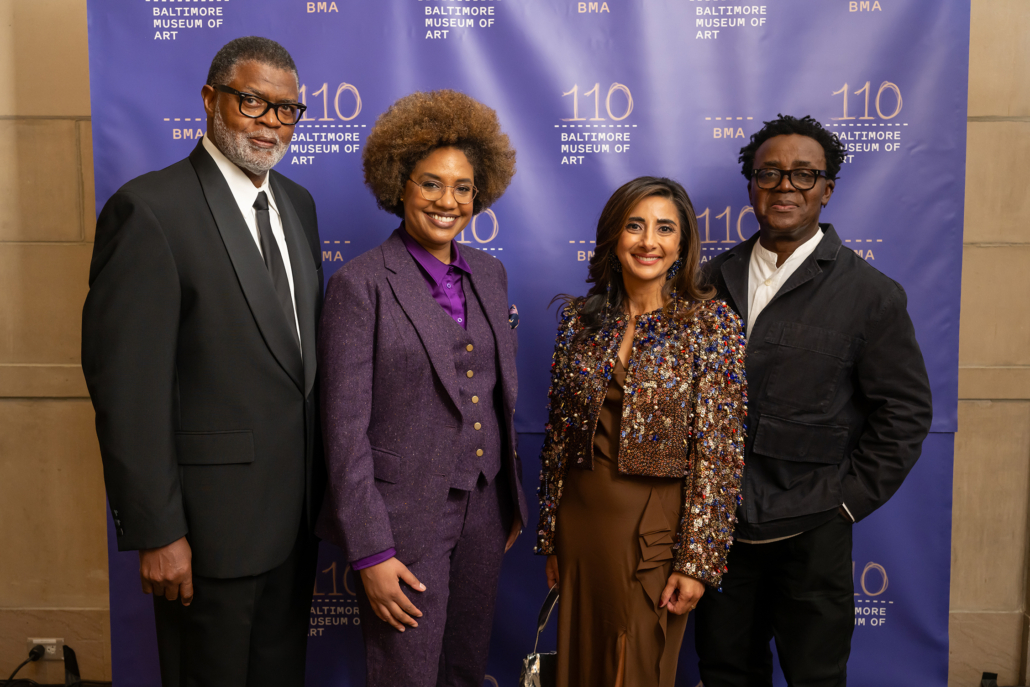
Paying tribute to the vast talents of two artists and a civil rights icon was the highlight of the evening, which included remarks, dinner, dancing, and dessert. British Ghanian artist and filmmaker John Akomfrah and artist, photographer, and advocate LaToya Ruby Frazier received the first-ever Artists Who Inspire Awards.
From left, Board of Trustees Chair James D. Thornton, artist LaToya Ruby Frazier, Baltimore Museum of Art Director Asma Naeem, and artist John Akomfrah. | Photo by Maximilian Frazier
Akomfrah’s films are studies in contrast, aesthetic masterpieces that beautify challenging histories with mesmerizing images and evocative soundtracks. A co-founder of Smoking Dogs Films, he generally makes single-and multi-channel films exploring memory, migration, post-colonialism, climate change and the African diaspora. Akomfrah represented Great Britain this year at the 60th Venice Biennale.
The inaugural Changemaker Who Inspires Award was bestowed upon the venerated civil rights lawyer, scholar, and BMA Trustee Sherrilyn Ifill. After serving as president and director-counsel of the NAACP Legal Defense Fund, from 2013 to 2022, Ifill returned to academia. She taught at Harvard Law School, was a scholor-in-residence at the Museum of Modern Art in New York (2023-24), and joined Howard University. Ifill is the inaugural Vernon E. Jordan, Jr., Esq. Endowed Chair in Civil Rights at Howard University Law School, where she established the 14th Amendment Center for Law & Democracy.
https://latoyarubyfrazier.com/wp-content/uploads/2016/12/LRF_logo_2016.png00Webmasterhttps://latoyarubyfrazier.com/wp-content/uploads/2016/12/LRF_logo_2016.pngWebmaster2024-11-29 14:26:262025-01-07 14:50:48Baltimore Museum of Art Celebrates 110th Anniversary
Museums, galleries and other art institutions are looking for measures to reduce their environmental footprints.
Visitors to the Hammer Museum’s show “Breath(e) Toward Climate and Social Justice” will be greeted by powerful works portraying the widespread impact of ecological degradation: photos of citizens in Flint, Mich., waiting for clean water, a painting of a fish created out of spilled crude oil and contaminated sediment.
But increasingly, museums are realizing that presenting artwork that addresses the climate crisis is not enough — they also must consider their own impact on the environment.
So, Hammer visitors won’t know that most of the art items were shipped by ground or sea, rather than air, resulting in far less carbon dioxide emissions. Or that the exhibition catalog was printed using FSC paper, which comes from forests managed in sustainable ways, and wrapped in translucent paper rather than the typical plastic shrink wrap.
“It would absolutely be hypocritical for us to put on a show about climate change without questioning our implication in climate change,” said Glenn Kaino, a Los-Angeles-based conceptual artist and co-curator of the show, which runs through Jan 5.
A photograph by LaToya Ruby Frazier titled “Moses West Holding a ‘Free Water’ sign on North Saginaw Street between East Marengo Avenue and East Pulaski Avenue, Flint, Michigan.”Credit…via LaToya Ruby Frazier and Gladstone Gallery
The Hammer exhibition is part of “PST Art: Art and Science Collide,” a series of events taking place through mid-February 2025 at about 70 museums, science institutions and other spaces across Southern California.
Museums and galleries have long shown artworks related to the climate crisis, but in recent years, there has been more of an urgency for directors and curators to look at the environmental cost of heating, cooling and lighting their buildings and packing, shipping and exhibiting their shows. That also includes examining the ecological toll of using imported materials or artists from distant shores rather than local artwork and artists.
In part, the pandemic jump-started the process; people had time to think about issues that were pressing but difficult to focus on during the busyness of everyday life. Within the art community, discussions arose about collaborative actions geared toward the climate crisis.
What would it “look like to actually be able to come together and feel like we are empowered to do something — and imagine a future we can live in, rather than feeling this kind of existential dread?” said Laura Lupton, an art and climate consultant, who helped develop and coleads the Climate Impact Program that is part of the PST Art event. She co-founded the nonprofit Artists Commit in 2020.
https://latoyarubyfrazier.com/wp-content/uploads/2016/12/LRF_logo_2016.png00Webmasterhttps://latoyarubyfrazier.com/wp-content/uploads/2016/12/LRF_logo_2016.pngWebmaster2024-10-30 16:09:222025-01-07 14:24:12The Art World Explores Concrete Ways to Fight Climate Change